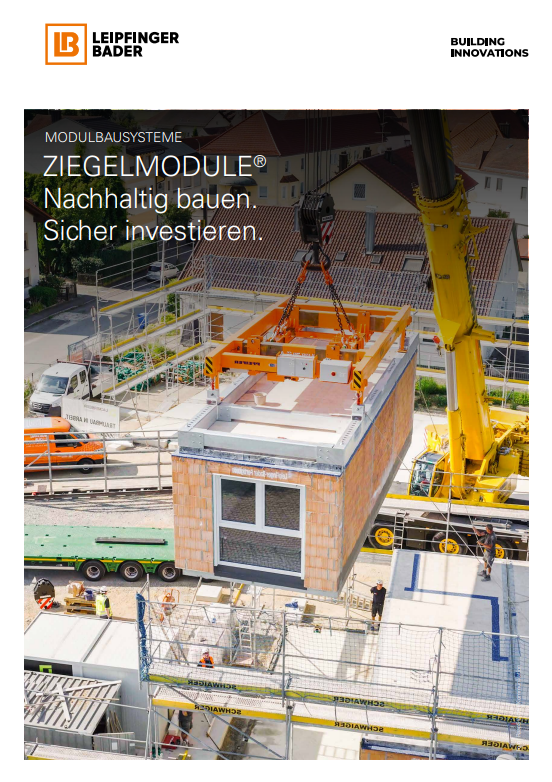
Build Smart. Shape the Future – Have Funding Opportunities for Brick Modular Construction Evaluated
Whether it’s a new construction project that meets the criteria of a climate-related subsidy program, employee housing, or housing for apprentices—with the right subsidy programs, financing costs can be reduced, and, in combination with tax depreciation options, a project’s economic viability can be improved. The respective subsidy programs—such as KfW Programs 296 and 297/298, as well as subsidy offerings from L-Bank Baden-Württemberg or BayernLabo—impose different requirements on the specific construction project, including energy efficiency and—depending on the program—additional sustainability and climate criteria.
Leipfinger-Bader’s modular construction system ZIEGELMODULE allows buildings to be designed and constructed using a method suitable for energy-efficient building concepts. Leipfinger-Bader ZIEGELMODULE thus provides a solid foundation for meeting the energy requirements for the entire building necessary to achieve specific Efficiency House levels. Whether a building meets the Efficiency House 40 standard, for example, depends, however, on the specific building design, the building services systems, and other project-related conditions.
This makes it possible to quickly create high-quality living space and—provided the relevant eligibility requirements are met—to design it in a way that potentially qualifies for funding.
Note: Actual eligibility depends on the specific program guidelines, application requirements, and individual project parameters. Binding information can only be provided by the relevant funding agencies or authorized advisory bodies.

Solid modular construction for a wide range of projects
The strength of modular brick construction lies in its tremendous flexibility. Whether for a single building or a large-scale expansion, modular construction using solid brick not only ensures speed and quality but also provides a solid foundation for compliance with the EH40 QNG standard. This ensures that your investment retains its value to the greatest extent possible and remains eligible for funding.
Typical areas of application include, for example:
- Housing construction:
Multi-story housing construction, serial owner-occupied homes, and rapid redensification - Specialized housing:
Retirement homes, student residences, and employee residences - Commercial & Administration:
Modern office buildings, administrative buildings, and commercial projects
Legal Notice / Disclaimer Regarding Funding Information
All information regarding government funding programs (e.g., KfW, L-Bank, BayernLabo, or other funding agencies) on this page has been compiled by Leipfinger-Bader with the utmost care. Nevertheless, Leipfinger-Bader assumes no liability for the accuracy, completeness, or timeliness of the information. Funding conditions, interest rates, grant amounts, and application requirements may change at any time without prior notice or may be suspended in whole or in part by the relevant funding agencies. Only the currently valid guidelines, information sheets, and terms and conditions of the funding institutions (e.g., KfW, L-Bank, BayernLabo, federal or state ministries) are authoritative. Binding information or advice regarding funding opportunities can only be provided by the respective funding agency or by authorized energy consultants, financial advisors, or funding agencies.Leipfinger-Bader assumes no liability for damages or financial losses arising from the use of or reliance on the information provided here.
Information current as of April 2026
KfW 296 – Climate-Friendly New Construction in the Low-Cost Segment (KNN)
- Up to €100,000 in financing per residential unit*
- Interest rates starting at 0.01%*
- Funding for space-efficient building designs*
The KfW Program 296 supports certain new residential construction projects in accordance with the applicable funding conditions. Ziegelmodule ’s compact floor plans—such as 1-room units measuring 27 m²—can be used for space-efficient housing concepts. Eligibility for funding is determined by the requirements of the overall project, including those related to costs, energy, greenhouse gas emissions, and life-cycle costs. Ziegelmodule can support serial construction; economic viability must be assessed on a project- and program-specific basis.
KfW 297/298 – Climate-Friendly New Construction (KFN)
- Up to €150,000 in financing per residential unit*
- Interest rates starting at 1.00%*
- Funding is also available for planning and QNG certification*
Through its “Climate-Friendly New Construction” program, KfW supports the construction and initial purchase of energy-efficient buildings that meet the Efficiency House 40 or 55 standard. Leipfinger-Bader’s “ ZIEGELMODULE ” (Energy-Saving House) systems, with their proven thermal insulation properties, can be an integral part of an energy-efficient building concept. In addition to construction costs, the programs also provide support for planning services and sustainability certifications. This creates modern living spaces—which can lead to low long-term energy costs and attractive financing.
BayernLabo – Income-Based Financial Aid (EOF)
- Grant of up to €2,200 per square meter of living space*
- Low-interest loans*
- Bonus for accessible or simple construction*
Income-Based Subsidies (EOF) support the construction of new rental housing for low-income households. ZIEGELMODULE enable cost-effective, solid-construction methods that can be tailored to specific projects to align with the subsidy objectives. In addition to potential grants of up to 2,200 euros per square meter of living space, developers benefit from potentially stable financing terms. This enables the creation of socially responsible housing that is economically viable and whose environmental qualities can be demonstrated on a project-by-project basis.
BayernLabo – Municipal Housing Support Program (KommWFP)
- Grant of up to 30% of eligible costs*
- Low-interest loan of up to 60%*
- Bonus of up to 5% for public housing*
The KommWFP program is aimed at cities and municipalities that are creating social or municipal housing. Thanks to their modular, solid construction, “ ZIEGELMODULE ” offer an ideal solution for municipal projects. The combination of a grant and a low-interest loan enables cost-effective implementation—especially for housing for healthcare workers, teachers, or other professionals in essential services.
BayernLabo – Affordable Housing for Young People (Students & Trainees)
- Up to €75,000 interest-free and with no principal repayment per residence*
- Commitment: 25–40 years*
- Rent: max. €260/month (€280 in metropolitan areas)*
The BayernLabo “Junges Wohnen” program supports the construction of housing for students and apprentices. Thanks to their compact size—starting at 25 m²—and their rapid, solid construction, “ ZIEGELMODULE ” units are well-suited for these projects. The program offers interest-free and principal-free loans with long-term commitments and clear rent caps. This creates modern, affordable housing for young people—built efficiently and designed to meet the specific project and funding requirements.
L-Bank Baden-Württemberg – Employee Housing
- Low-interest loans starting at 0.0%*
- Up to 36% base funding + 25% innovation bonus*
- + 5% subsidy for barrier-free housing*
Through its “Employee Housing” funding program, L-Bank supports companies, municipalities, and developers in building housing for employees. ZIEGELMODULE enables the rapid, large-scale, and cost-effective implementation of such projects. The interest-free loans and generous grants for innovative construction methods are particularly attractive. This results in modern housing suitable for energy-efficient building designs that helps retain skilled workers while remaining affordable in the long term.
L-Bank Baden-Württemberg – Affordable Housing for Young People
- Grant of up to 40% of eligible costs*
- Up to €47,900 per bed*
- Additional grant of up to €2,200 for accessibility*
The “Junges Wohnen” program supports the construction and renovation of housing units for apprentices. Thanks to their compact size and high energy efficiency, “ ZIEGELMODULE ” provide ideal conditions for this funding program. The grants make the construction of apprentice dormitories particularly attractive, while the 30-year lease and occupancy commitment ensures stable rents and planning certainty. This creates new housing for young people—modern, efficient, and eligible for funding.
Discover funding opportunities – get a no-obligation consultation
From apartment to townhouse:
Scalable living space
The true strength of modular brick construction lies in its intelligent scalability. Based on a simple modular principle, combining just a few modules can create completely different types of living spaces—from functional micro-apartments to spacious, multi-story terraced houses for the whole family.
The following floor plans and furnishing examples serve as inspiration and impressively demonstrate the potential this system offers for your project.
We would be happy to advise you on your project.
The first step toward a successful project is a reliable assessment by experienced specialists. The team of experts at Leipfinger-Bader is ready to analyze the potential of modular brick construction for your specific project. All we need is some initial key data, a rough sketch, or even just a specific question.
Send us a non-binding inquiry to create a solid basis for your further decisions.
online catalog
Experience the brick module principle
The catalog provides a concise overview of Leipfinger-Bader's modular construction system – from concept and production to completed projects.
Among other things, it contains detailed information about:
- Technical data for ZIEGELMODULE
- Information about hybrid construction
- Floor plan examples
- furnishing options
- reference objects
- Planning notes
- and much more
Learn how living spaces are created using industrially prefabricated brick modules. The requirements for EH40 and QNG classifications, as well as potential financial incentives, can also be evaluated as part of the individual planning process.